
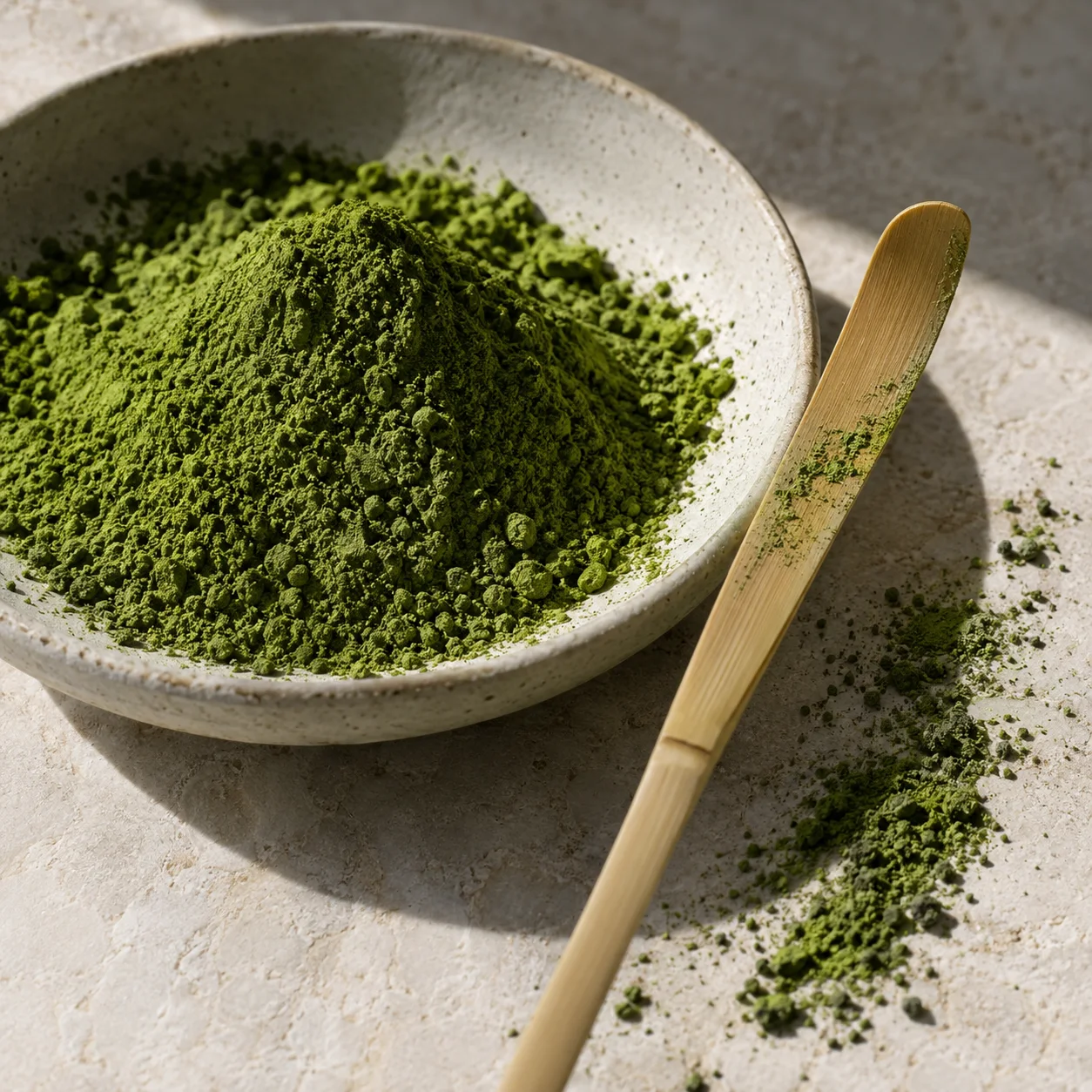
Cover: AI-generated editorial illustration, not a location, maker or product photograph.
A familiar name deserves a closer map
Uji often arrives in a kitchen as a word beside matcha. It is easy to let that word become a complete imagined landscape: a single town, a single kind of field, a single tea. Public accounts from Uji and Kyoto offer a richer picture, connecting urban history, cultivation and several ways of making green tea.
Start by allowing the name to raise a question. Does the maker mean the city, the wider tea tradition or a particular growing location? Each answer tells us something different, and the distinctions make the tea more interesting to follow.
The tea region is wider than the city
Japan’s Ministry of Agriculture, Forestry and Fisheries explains that Uji tea can use leaves grown in Kyoto, Nara, Shiga and Mie prefectures, processed by Kyoto-based producers using methods originating in the Uji region. The name therefore carries a production tradition as well as a geographical association.
This is why a useful label can name both Uji tea and a more precise source for the leaf. The two details answer different questions. When that source is supplied, keep it in the story: it tells you where the agricultural part of this particular tea began.
One surviving garden changes the picture
Uji City’s account of the Uji Shichimeien, the seven celebrated tea gardens, says that most have disappeared and identifies Okunoyama as the surviving garden. The old names preserve a memory of cultivation within a place that has changed.
That single detail makes an older tea history feel less abstract. Continuity does not require every field to remain in the same place or every street to look unchanged. A surviving garden and remembered names can sit beside a modern city. They invite us to ask what has endured, what has moved and who has kept the knowledge in use.
Shade is something people construct
At Chazuna, Uji’s tea and history park, a recreated tea landscape refers to gardens once cultivated on a river island. The park explains the local practice of growing tea under a cover, called oishita cultivation. Its presentation makes the covering itself part of what visitors can learn about tea.
That is an important change of perspective. The landscape is not only weather and soil; it also includes structures and decisions. A cover placed over living plants is a visible sign of an intended result. Reading a field means noticing that intervention, along with the plants beneath it.
Matcha belongs to a larger tea vocabulary
The Kyoto Prefectural Tea Chamber presents Uji through matcha, sencha and gyokuro. These names open different routes through the same regional tea culture. MAFF explains that matcha comes from ground tencha, whose leaves are steamed and dried without the rolling used for sencha.
The comparison gives an ordinary tea drinker something concrete to explore. Follow one leaf through a stated process and then compare another tea made differently. A cup of sencha can broaden your understanding of a place first encountered through matcha, without requiring either cup to represent the whole region.
Read the next tin with the place in mind
Look for the growing location when provided, the tea type and the producer’s account of processing. Let each detail keep its own meaning. A city name tells one part of the story; a named garden, a harvest and the work of a processor can make it more particular.
Uji’s interest grows with that specificity. The remembered gardens, covered cultivation and distinct tea forms give the name depth. Once those connections become visible, the powder in a bowl belongs to a much larger world of fields, workshops and people making choices over time.
Sources and further reading:
- Japan MAFF: Uji tea definition, tea types and processing
- Uji City: the seven historic Uji tea gardens
- Chazuna tea and history park: recreated tea landscape and covered cultivation
- Kyoto Prefectural Tea Chamber: an introduction to Uji tea
An editorial article based on the public sources listed above.
